Our Data Center Relocation Process
How we work
A phased program, not a household move
We plan like an engineering program: dependencies mapped, cutovers staged, and a rollback path ready before anything leaves the rack.
Discovery & dependency mapping
We inventory hardware, applications, and interdependencies so nothing moves before its dependencies are understood.
Runbook & rollback planning
Every phase gets a sequenced runbook with checkpoints, owners, and a documented rollback path.
Staged cutover
We migrate in phases, validating each stage against acceptance criteria before proceeding to the next.
Verification & handover
Post-move validation, audit-grade documentation, and a clean handover to your operations team.
Phase 1: Discovery and dependency mapping
Every move starts with understanding what you actually have. We build an inventory of racks, servers, storage, network gear, power equipment and cabling, and we map how the pieces depend on each other: which applications share a host, which links carry production traffic, which systems must come up before others.
This is where most avoidable problems are caught. A shared storage array that supports three applications cannot be moved on the same night as one of them, and a circuit that takes weeks to deliver sets the earliest possible date for everything behind it. Finding those constraints in discovery costs a conversation. Finding them on move day costs an outage.
Phase 2: Runbook and rollback planning
The runbook turns the discovery findings into a sequence: what moves in which wave, who is responsible for each step, how long each step is expected to take and what has to be verified before the next one starts. Each wave also gets a rollback point, so if something does not come up as planned there is a documented way back to a known-good state.
We review the runbook with your technical team and anyone whose systems are affected, and we adjust it until the people who will be on call agree it is realistic.
Phase 3: Staged cutover
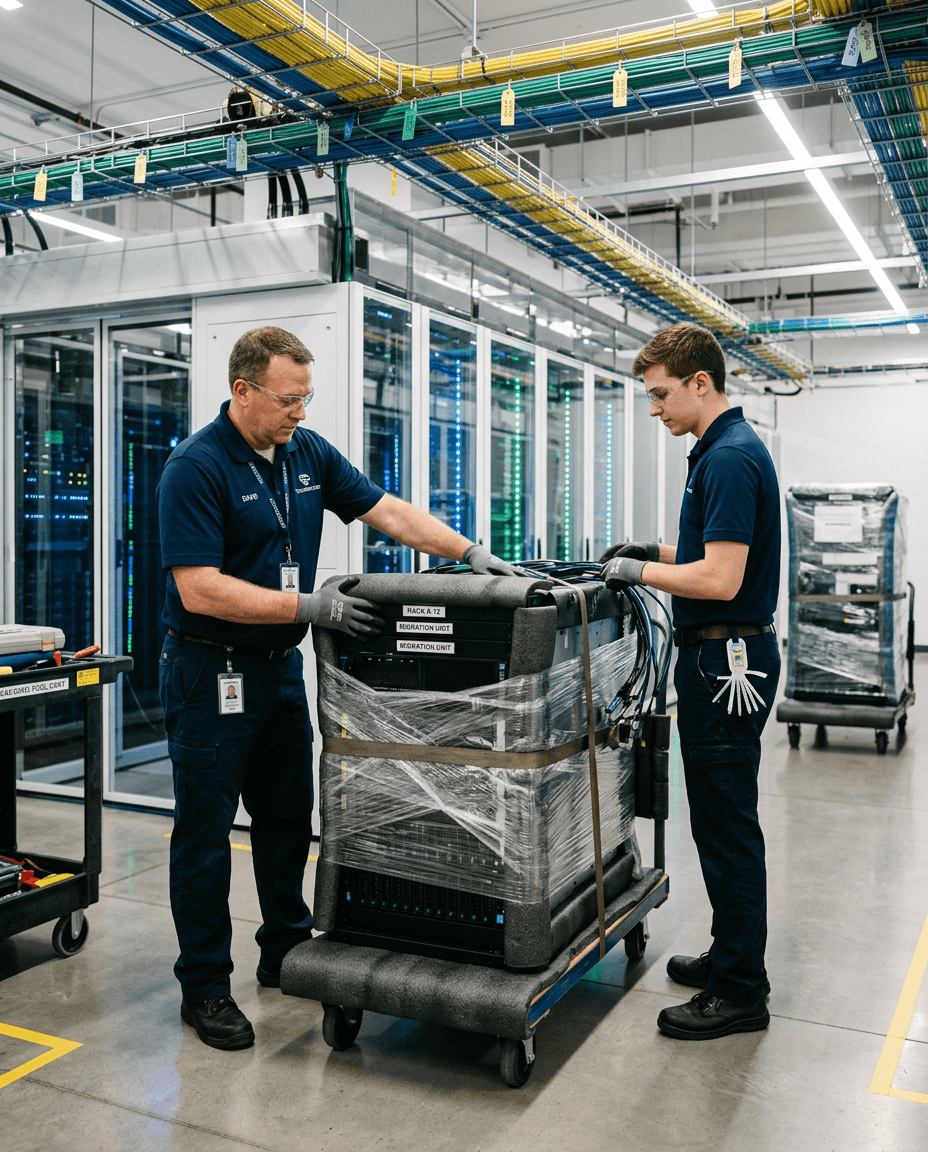
We move in phases rather than all at once. For each wave the team powers equipment down in the agreed order, de-installs and labels it, packs it, transports it, re-installs it and brings it up, then checks it against the acceptance criteria in the runbook before the next wave begins.
Staging limits risk. If a wave exposes a problem, only that wave is affected and the rest of the environment is still where it was supposed to be.
Phase 4: Verification and handover
A move is not finished when the truck is empty. We confirm each system is racked, cabled, powered and reachable as documented, work through the validation steps with your team, and hand over the records: updated inventory, cable documentation and chain-of-custody logs. Your operations team takes over a documented environment instead of an unlabeled one.
How equipment is handled in transit
Our team brings 20+ years in moving & logistics to the physical side of the work. Servers and network gear are vulnerable to static, shock and vibration, so handling follows a consistent routine:
- Every device is labeled, photographed and logged before it comes out of the rack.
- Equipment is wrapped in anti-static, shock-absorbing materials and crated where the route or the equipment calls for it.
- Loads travel on air-ride trucks with exclusive use of the vehicle, so nothing is co-loaded.
- Custody is recorded at every handoff, from the origin rack to the destination rack.
- Moves across state lines are handled as domestic long-haul logistics, and moves abroad include export crating and customs coordination.
What we need from you
The process works best when we have access to a few things early: an equipment list or rack elevations, a contact who can answer application and dependency questions, the target window and any blackout dates, details of the destination site and its receiving rules, and any compliance requirements that affect handling. If you do not have all of this yet, that is normal, and discovery is how we fill the gaps.
Why one accountable team matters
Splitting a move between a planner, a mover, an IT crew and a freight carrier creates handoffs that nobody owns. Our process keeps discovery, planning, execution and validation with the same people. For an illustration of how that plays out, read an example scenario of a move run by one full-service team, or see how we scope common programs.
When you are ready to start, request a quote and tell us about your environment.
Common questions
Frequently asked questions
- Do you take responsibility for the whole move?
- Yes. Planning, de-installation, packing, transport, re-installation and verification are handled as one program with a single point of contact, so there is no gap between vendors.
- What happens if something does not come up after a wave?
- Each wave has a documented rollback point. If a system fails its checks we follow the rollback path in the runbook instead of improvising, and we work the issue with your team before continuing.
- Can you move equipment in phases to avoid downtime?
- Yes. Phased moves are the default. Discovery shows which systems can move together and which have to be sequenced, and the runbook is built around your maintenance windows.
- Do you handle the equipment we are not taking with us?
- Yes. Retired equipment can be decommissioned with documented sanitization, or sold through our buy back program for cash or credit toward the move.Learn about equipment buy back
Want to work through the phases on paper? Use our printable data center migration checklist alongside the process above.